January Newsletter: 2025 Lookback, Decembers Progress, Macro and 2026 Outlook
- Ameer Omar
- Jan 16
- 5 min read

December 2025: The Year Crypto Grew Up the Hard Way
Crypto didn’t end 2025 with fireworks like previous 4-year cycles have. It ended with a collective exhale, as prices wallowed. BTC opened the year around ~$96,000 and ended it around ~$93,000.

ETF outflows reflected tax-loss harvesting, not panic. XRP ETPs saw inflows, and futures open interest ticked higher while options positions expired. No meaningful Bitcoin selling by early-era whales appeared on-chain.
But the structural signals were louder than the price charts.
DTCC and JP Morgan advanced major tokenization pilots. Ethereum and Solana made meaningful technical progress. A Senate markup of crypto legislation is scheduled for mid-January. The US moved against Venezuela’s leadership and injected fresh geopolitical uncertainty into the dollar’s outlook.
2025 in Review: The Highs, Lows, and Strange In-Betweens
This year will be remembered less for price action and more for what it revealed about crypto’s maturity arc.
We saw memecoins endorsed by a former First Family draw nine-figure liquidity, a strategic Bitcoin reserve built from seized coins, a softened SEC posture, and a pivot away from governance tokens toward real cash flow. We saw MicroStrategy rebrand as Strategy and accumulate another one percent of Bitcoin’s supply. We saw Trump pardon CZ, tariffs disrupt markets, and a single day in October wipe out $20 billion in leverage.

We watched Bybit lose $1.5 billion, Balancer lose $100 million, and the ecosystem lose patience with anything that looked like empty speculation.
But we also saw Circle file to go public, the GENIUS Act become law, Coinbase enter the S&P 500, and Ethereum ship Fusaka. We watched Coinbase buy Deribit and Echo. Kraken bought NinjaTrader. Ripple bought Hidden Road. You could argue that crypto has reached the phase of real corporate consolidation.
Through it all, one truth kept rising to the surface: protecting capital mattered more than chasing miracles. Bitcoin is finishing the year roughly 4 percent below where it started.
The Altseason That Never Came
Every cycle teaches a new version of the same lesson. This year, it was simple: altseason is no longer a reliable framework. The dispersion was too wide. The winners were too obvious. The losers were everywhere.
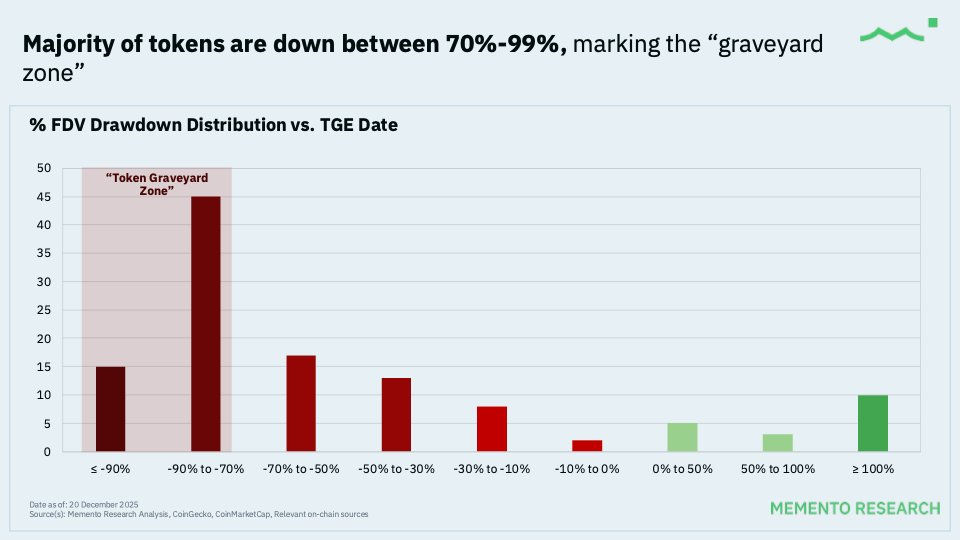
If you survived 2025 without being trapped in a lagging token, you won. If you picked the right assets, you did even better. The altseason myth survived only because people remembered the past too fondly. In reality, only a small set of projects rewarded the risk. As the image below shows, nearly all newly launched tokens were down only.
Top Themes in 2025
Launchpads began in 2025 as a harmless idea and ended as a conveyor belt for extraction. What was once a gateway for community participation became a game dominated by insiders who understood how each launch would be farmed, drained, and discarded.
Perps DEX farming suffered the same fate. What worked in a rising market, when fees were trivial relative to altcoin gains, collapsed once volatility normalized. The counterparty shifted from casual gamblers to professional desks with better information and better tools.
HYPE was the exception. Its points program was the most profitable trade in DeFi for almost two years. But even that meta ended the moment the token launched, and incentives stopped rewarding behavior that no longer made sense.
If there was a breakout category in 2025, it wasn’t memecoins. It wasn’t NFTs. It wasn’t high-yield farms. It was prediction markets. Most people think of them as ways to gamble. That surface understanding misses what is actually happening. These markets became engines for aggregating information in real time. They turned uncertainty into tradable probabilities. They exposed how little confidence investors had in traditional polling, media narratives, or expert opinions.
Volumes hit billions per week. The category went from fringe curiosity to one of the few places where retail, analysts, and professionals traded on equal footing.

Macro: A World Pulled in Different Directions
The global economy enters 2026 without a consensus narrative.
The US looks resilient at first glance, but the labor market is cooling, and inflation remains sticky. AI-driven capital spending is strong, yet wage pressure and slower hiring weigh on consumers. Forecasts diverge sharply. Some banks expect above-trend growth. Others see recession odds creeping higher.
Europe appears steadier. Inflation is normalizing. Germany is deploying large fiscal packages for infrastructure and defense. But exports are shaky, and new US tariffs complicate supply chains.
China remains a two-track story. Manufacturing is powerful. Domestic demand is not. Real estate drags on growth. Sector consolidation efforts may help long-term stability, but will weigh on headline numbers.
Whether crypto’s next big chapter is written by global liquidity, risk-off contagion from AI stocks, or another geopolitical shock remains unclear. What’s clear is that crypto is now sensitive to all of it.
Crypto’s Identity Test for 2026
The industry now faces a profound question: can it preserve decentralization and permissionless access while attracting the largest pools of global capital? Or will 2026 be the year crypto bends too far toward institutional comfort?

The signs are mixed. Onchain activity is at an all-time high, with Ethereum surpassing 2.2 million transactions on December 29. But incentives are shifting. Compliance requirements are growing. Regulation is normalizing. And some builders may find themselves pulled toward the preferences of institutional allocators rather than the values of early users.
The coming year will test whether crypto can grow without losing its soul.
Where Real Opportunities Sit in 2026
The strongest opportunities share four traits:
Distribution that reaches non-crypto users
A clear path to capturing value
Teams that understand their users
A use case that genuinely requires a blockchain
Polymarket is the most obvious example. People don’t use it because they care about Polygon. They use it because it answers real questions better than any pollster or pundit. Its mechanics happen to be powered by crypto, not sold as crypto.
December’s Micro Stories: Signs of a Pulse
A few stories broke through the year-end haze:
• Bitcoin ETFs saw their strongest inflow day since October, surpassing $1.16 billion in the first days of 2026 • Global digital asset products absorbed more than $47 billion for the year • Coinbase earned a Buy rating from Goldman Sachs • Bank of America signaled wealth clients may soon allocate up to 4 percent into crypto • Strategy added another $116 million in Bitcoin • Bitmine bought another 33,000 ETH • Robinhood shifted product design toward advanced traders • Lighter quietly began buying back its token • Jupiter launched its JupUSD stablecoin • NFT Paris canceled its event due to financial strain • Ledger’s commerce partner suffered a breach • Starknet faced another multi-hour outage
Each of these stories reveals the same theme: the industry is still in motion, even when price says otherwise.
Closing Thought: The Market Is Resetting, Not Retreating
Crypto ended 2025 with a strange calm. Not euphoria. Not despair. Just a quiet reset.
A year that began with memecoin mania and ended with major tokenization initiatives from Wall Street tells you all you need to know. This market is becoming both more serious and more unpredictable at the same time.
Being early is no longer enough. Being right matters again. And 2026 will reward those who understand that the next cycle will not look like the last one.
Stay alert and we'll see you onchain in 2026.


Comments